
Do you have an experience with lupus to share?
Learn more about our lupus registry, RAY, and how you can be a part of lupus research.



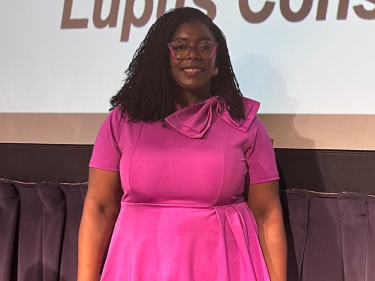
Often described as inquisitive in her younger years by her father, Dr. Joy Buie always had a keen interest in questions that were more mature than her age.
“Even as a child, I was an avid observer of the world around me,” Dr. Buie said. “I was rarely satisfied with accepting things at face value. I was less interested in how things were and more compelled by why they were that way — and, importantly, how they might be changed.”
Dr. Buie recalls pondering questions that addressed big-picture questions about life. Why do some people live long, vibrant lives while others are taken early by unexplained symptoms or an unexpected diagnosis? Why does health seem almost arbitrary, given generously upon some and withheld from others?
What began as questions born of observations of the world around her, including the stark differences in lifespan among her own relatives, led to a career dedicated to understanding, and advancing the science that seeks not only to explain illness, but to prevent it.
Now the Vice President of Research at the Lupus Foundation of America, Dr. Buie’s work stems from that curiosity as well as early career endeavors as a biomedical scientist where she focused on the disease process in lupus. By dedicating herself to research, Dr. Buie hopes to increase the number of patients who see themselves reflected in the data that shapes their care.
“When research meaningfully captures the cultural, socioeconomic and geographic realities of those living with lupus,” Dr. Buie said, “it strengthens trust, improves recruitment, enhances outcomes and ultimately elevates quality of life. If our work contributes to reducing disparities in diagnosis, access to treatment and long-term outcomes, then we are advancing not only science—but equity.”
At the Lupus Foundation of America, research strategy focuses on advancing clinical care, expanding equitable access and accelerating patient-focused drug development. By engaging clinicians, researchers, industry partners and policymakers, the LFA promotes person-centered innovation for those living with lupus and their families.
Some of the LFA’s main research initiatives include Addressing Health Inequities in Minorities (Lupus AIM), which focuses on reducing health gaps in minoritized communities; IMPACT, which supports research and faster development of better treatments; Addressing Lupus Pillars for Health Advancement (ALPHA), a global effort to identify and address urgent barriers in lupus care and research; and Lupus Science & Medicine, an online journal that shares the latest lupus research to help doctors and scientists advance understanding and care.
Through strengthening disease registries that track people’s health over time, supporting early-career investigators and investing in forward-looking areas such as CAR-T therapy education, the LFA is shifting lupus research from a reactive model to one that is predictive, preventive and responsive to community needs. This forward-looking, community-responsive approach is also reflected in the leadership and values shaping the next generation of lupus research. Dr. Buie believes that the future of research depends on women who are willing to ask harder questions and build more inclusive systems.
“Women’s History Month is a reminder that progress is rarely accidental,” Dr. Buie said. “It is intentionally built by women who persisted despite structural, social and cultural barriers. In lupus, where nearly 90% of those affected are women, this month feels especially meaningful. Women’s History Month reinforces the urgency of advancing research that prioritizes women’s health and honors the women—patients, caregivers, researchers and mentors—who have shaped science.” Dr. Buie’s passion for equitable, community-centered research doesn’t exist in a vacuum. It’s part of a broader, shared commitment at the Lupus Foundation of America — one carried by colleagues who bring their own experiences and perspectives to the work.

Among them is Senior Manager of Patient Engagement and Health Outcomes, Safoah Agyemang, whose journey into lupus research adds another personal and global dimension to the Foundation’s mission.
Born in Ghana and raised in the United States, Agyemang has a unique perspective on health care and research. In many parts of Africa, research infrastructure and participation are still developing, and the need for locally relevant data and equitable representation on a global scale is immense. Because of her experience, she is committed to work that ensures diverse populations are represented in research.
Academic training in biology and medical science also sparked a broad interest in research and its ability to improve health outcomes and inform better care. For her graduate research, Agyemang focused on lupus, which deepened her understanding of the disease and its disproportionate impact. That work became deeply personal after losing a close church member to lupus due to limited disease awareness and access to resources, according to Agyemang. This experience reinforced the urgent need for education, advocacy and patient-centered research.
“Working with the Lupus Foundation of America allows me to learn how to bridge science, education and lived experience,” Agyemang said. “Contributing to work that educates communities and centers the voices and experiences of people living with lupus (and their support systems) gives my work deeper purpose.
Currently, Agyemang leads patient engagement and health outcomes research for the Research Accelerated by You Lupus Registry (RAY®), an international patient-powered registry that collects information over longer periods of time from people living with lupus to elevate their voice in lupus research.
Learn more about our lupus registry, RAY, and how you can be a part of lupus research.
Her work focuses on increasing participation in clinical trials, improving diversity in research and generating patient-centered insights that inform clinical research, care and therapeutic development.
“I was drawn to this work because it shifts research from being done about patients to being done with them,” Agyemang said. “I hope this work helps ensure that lupus research reflects the real experiences of those living with the disease.”
Agyemang’s work also focuses on improving representation, capturing symptom burden and quality-of-life data and increasing awareness of clinical research opportunities. This can help accelerate more equitable care and better therapies.
She hopes the model of patient-centered research will continue to expand globally and beyond lupus research, strengthening participation and advancing health equity in regions where research infrastructure is still evolving while contributing to broader progress in health care overall. Her commitment to advancing inclusive research is deeply intertwined with her reflections on identity, representation and the example she strives to set for future generations.
“As a young African American woman of Ghanaian heritage and a mother to a young daughter, I am mindful of the example I am setting and the legacy I am helping to shape,” Agyemang said. “It reminds me of the responsibility to expand representation, create pathways and help ensure the next generation of girls grow up seeing themselves reflected in leadership, science and health care. When women are supported and empowered, what we carry multiplies, which strengthens families, communities and future generations.”
Throughout her career, Agyemang has worked with mentors who challenged her to grow and who reflected the leader she wanted to become. Their guidance not only sharpened her scientific interest but also reinforced the importance of leading with integrity and intention. Those lessons continue to shape how she approaches her work and the advice she now shares with others. “Pursue work that aligns with your values,” Agyemang said. “When your research is rooted in purpose, it has the power to transform lives and shape the future.”
Authored by:
Ian Decker
This blog post and the lupus resources found on the National Resource Center on Lupus are, in part, supported by the Centers for Disease Control and Prevention under Cooperative Agreement Number NU58 DP006139. The contents are solely the responsibility of the developers. Points of view or opinions do not, therefore, necessarily represent official views of the Centers for Disease Control and Prevention or the Department of Health and Human Services.
This blog post is for educational and information purposes only. Consult with your doctor/health care team for medical advice.